
Steaming beech: even colour and stability before drying
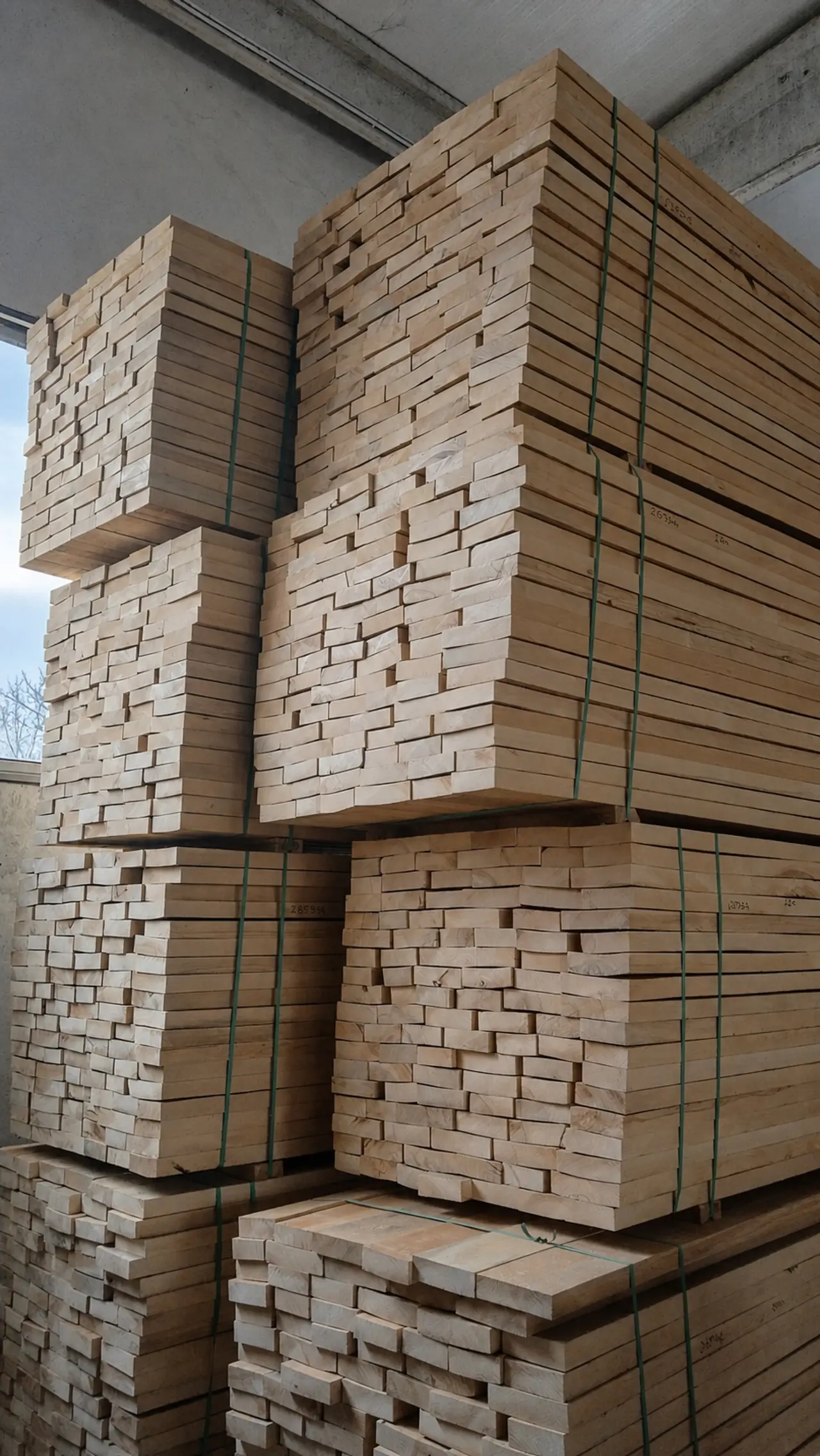
Beech is one of the most widely used hardwoods in furniture and component manufacturing, but it has a trait that calls for special treatment: it tends toward uneven colour and the formation of red heart, and it cracks and moves easily if dried without preparation. That is why quality beech is, as a rule, steamed first and only then dried.
Steaming is a hydrothermal treatment: the stacked wood is exposed to saturated steam in a closed chamber at elevated temperature, over several hours or days — depending on thickness and the desired effect. Heat and moisture penetrate the entire cross-section and change the wood from within, not only at the surface.
The most visible effect is colour. Steaming evens out the tone of beech and gives it a warm, pinkish-red hue, while the differences between sapwood and red heart are reduced. For the customer this means a calmer, more predictable appearance across the whole batch — important when lamellas are glued into a panel or when a uniform furniture colour is required.
The mechanical effect is just as important. Steaming relieves internal stresses and slightly softens the structure, so the wood cracks and warps less during subsequent drying. This reduces waste and yields a more stable raw material for further processing — cutting, gluing and calibration.
After steaming, the wood goes to kiln drying, where moisture is brought down to the target 8–10%. Steaming and drying are therefore two linked stages: the first prepares and evens out the wood, the second stabilises it to working moisture. Only their combination produces a material suited to demanding series production.
The end result is steamed beech with even colour, relieved stresses and predictable behaviour — the basis for edge-glued panels, bed components and other parts where both appearance and stability must be consistent from batch to batch.
The greatest advantage of steamed beech is predictability — in both appearance and behaviour. Unsteamed beech shows abrupt colour differences and a higher risk of cracking during drying, so it varies from board to board. Steaming evens the tone into a recognisable warm hue that the market values, and the relieved stresses mean less cracking and less waste. The wood also becomes somewhat softer to work, so tools give a clean cut and a smooth surface more easily.
That is why steamed beech is the best choice wherever appearance must be consistent — in edge-glued panels, visible furniture elements and bed components. The customer gets a batch in which lamellas lay up into a calm, even surface with no patchiness, and with fewer rejected pieces. Less rework, a uniform result and a colour the market has proven to accept — this is the combination that makes steamed beech worth more than the extra step costs.